The sun dips just below the horizon, drowning out the last of the light that covered the boat. I pull on my thick, 5mm wetsuit, ready to plunge into the cold water. I have an understanding of what’s waiting for me below the pitch black surface and rough waves, but it hasn’t fully set in yet. Today, I will be seeing a phenomenon best known as a manta ray night dive. Where the divers will perch on the rocks at the bottom of the ocean, light up their torches, and attract plankton. Manta rays are harmless fish with no stingers or barbs on their tails. They are filter feeders, whose primary prey is zooplankton. Some can even have wingspans of up to 26 feet.
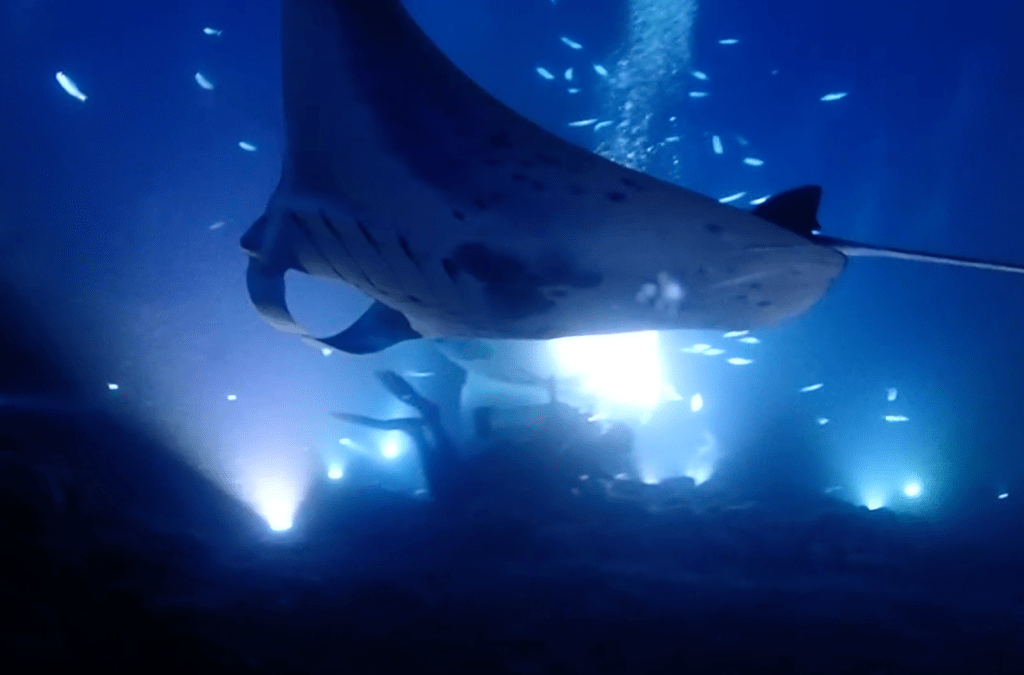
With one big step, my fin breaks the water and descends into complete darkness. I can only see what is illuminated with my tiny torch. I wield it like a sword, the light slashing into any signs of movement. In the distance, about one hundred feet away, there is a faint column of light. As I swim closer, I can see large shadows moving through the beam of light. A circle of rocks and sand surrounds a pile of lights. Every muscle in my body shakes from a mix of excitement and anticipation.
Manta rays come from every direction towards the light, and they swoop through them like birds catching prey. I’m captivated by how the mantas dance and fly through the water, my eyes nearly pop out of my head. I lost attention on the rays for just a moment. A red cardinalfish is flitting around my light, trying to catch any plankton that the rays miss. All of a sudden, the most stunning female manta ray gracefully sailed right over my head. So close that I could see every pattern on her white underbelly.
It’s moments like these that remind me of why the ocean, the environment, and conservation are so important. It’s hard to see the effect of conservation in the wild, and it’s easy to get disheartened by everything that is undoing the billions of years of evolution that have happened. Seeing these delicate, humongous, and beautiful fish showed me why they and their habitats must be protected. Mantas are victims of bycatch, habitat loss, and entanglement. Mantas do not become mature enough for mating until they are eight to ten years old, and only have one pup every two to three years. Manta rays are being killed off at a higher rate than they are being born, making them endangered.
It is this night, this moment, where I commit to doing everything I can so that future generations have the opportunity to feel the awe I felt seeing the elegant waltz of seven wild mantas in the middle of the night.
 Aila Webster
Leave a comment